
Natalia Sarkisian

Associate Professor of Sociology
Boston College

|
Natalia Sarkisian
Associate Professor of Sociology
|
|
I received my Ph.D. (2005) and M.A. (2001) in Sociology from the University of Massachusetts Amherst. Previously, I earned a B.A. in Sociology from the State Academy of Management in Moscow, Russia. I am an Associate Professor in the Sociology Department of Boston College since 2005. I am also affiliated with the Sloan Center on Aging and Work/Workplace Flexibility. My research interests include race, gender, and class, family sociology, aging and the life course, and quantitative methods.
Sarkisian, Natalia, and Naomi Gerstel. 2012. Nuclear Family Values, Extended Family Lives: The Importance of Gender, Race, and Class. New York: Routledge.
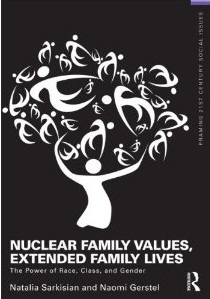 When discussing families, politicians and sociologists alike typically
focus on parents and their young children. They are especially likely
to emphasize issues related to marriage, highlight the role of
fathers, and promote the importance of a two-parent nuclear
family. This book argues that such rhetoric is a poor reflection of
the everyday lives of many Americans for whom family includes aging
parents, grown up children, adult siblings, aunts, uncles, cousins,
grandparents, and grandchildren. This book questions the focus on
nuclear family by highlighting the roles that these extended family
members play in the lives of Americans. It demonstrates that many
Americans spend substantial amounts of time with their relatives,
frequently rely on extended family members for help, and provide
assistance in return. The book argues that this narrow emphasis on
marriage and the nuclear family, with its exclusion of the extended
family, is particularly likely to overlook family experiences of
women, racial/ethnic minorities, and low-wage workers and the poor for
whom extended families are centrally important. This book also
addresses another facet of the popular rhetoric on families--that
emphasizing the role of marriage as social glue. For many social
critics and observers, not only is the nuclear family the basic unit
of society, but marriage is the foundation of the community. Marriage,
to them, is the endangered basis of a healthy society, whose fragility
threatens children and adults as well as the broader community. In
contrast, this book demonstrates that in many ways, marriage actually
separates men and women from other social connections and therefore
detracts from ties to extended families and broader communities. These
isolating effects of marriage are felt across race and class, but
because those with fewer economic resources are more likely to rely on
extended family, these effects of marriage are particularly costly to
them. The book concludes with an examination of the impact of nuclear
family rhetoric on social policy. In line with this rhetoric, many
social policies, including family and medical leave policies,
Medicaid, gay and lesbian marriage, welfare reform, and policies on
grandparents, are geared towards the nuclear family. We argue that
this inattention to the extended family reduces the effectiveness,
reach, and potential power of family policy. The book concludes that
not only does a focus on marriage and the nuclear family miss a great
deal of family life and denigrate poor and minority families, but it
also facilitates social policies that discriminate against women,
people of color, and the poor and thereby reduces the power of social
policy to improve lives of Americans.
When discussing families, politicians and sociologists alike typically
focus on parents and their young children. They are especially likely
to emphasize issues related to marriage, highlight the role of
fathers, and promote the importance of a two-parent nuclear
family. This book argues that such rhetoric is a poor reflection of
the everyday lives of many Americans for whom family includes aging
parents, grown up children, adult siblings, aunts, uncles, cousins,
grandparents, and grandchildren. This book questions the focus on
nuclear family by highlighting the roles that these extended family
members play in the lives of Americans. It demonstrates that many
Americans spend substantial amounts of time with their relatives,
frequently rely on extended family members for help, and provide
assistance in return. The book argues that this narrow emphasis on
marriage and the nuclear family, with its exclusion of the extended
family, is particularly likely to overlook family experiences of
women, racial/ethnic minorities, and low-wage workers and the poor for
whom extended families are centrally important. This book also
addresses another facet of the popular rhetoric on families--that
emphasizing the role of marriage as social glue. For many social
critics and observers, not only is the nuclear family the basic unit
of society, but marriage is the foundation of the community. Marriage,
to them, is the endangered basis of a healthy society, whose fragility
threatens children and adults as well as the broader community. In
contrast, this book demonstrates that in many ways, marriage actually
separates men and women from other social connections and therefore
detracts from ties to extended families and broader communities. These
isolating effects of marriage are felt across race and class, but
because those with fewer economic resources are more likely to rely on
extended family, these effects of marriage are particularly costly to
them. The book concludes with an examination of the impact of nuclear
family rhetoric on social policy. In line with this rhetoric, many
social policies, including family and medical leave policies,
Medicaid, gay and lesbian marriage, welfare reform, and policies on
grandparents, are geared towards the nuclear family. We argue that
this inattention to the extended family reduces the effectiveness,
reach, and potential power of family policy. The book concludes that
not only does a focus on marriage and the nuclear family miss a great
deal of family life and denigrate poor and minority families, but it
also facilitates social policies that discriminate against women,
people of color, and the poor and thereby reduces the power of social
policy to improve lives of Americans.
McNamara, Tay, Marcie Pitt-Catsouphes, Natalia Sarkisian, Elyssa Besen, and Miwako Kidahashi. Forthcoming. "Age Bias in the Workplace: Cultural Stereotypes and In-Group Favoritism." The International Journal of Aging and Human Development.
Sarkisian, Natalia, and Naomi Gerstel. 2016. "Does Singlehood Isolate or Integrate? Examining the Link between Marital Status and Ties to Kin, Friends, and Neighbors." Journal of Social and Personal Relationships, 33, 3, 361-384.
***Article selected to be highlighted in "Relationship Matters" podcast (#49)***
Sweet, Stephen, Natalia Sarkisian, Christina Matz-Costa, and Marcie Pitt-Catsouphes. 2015. "Are Women Less Career Centric Than Men? Structure, Culture, and Identity Investments." Community, Work, and Family, 19, 4.
Karamnov, Sergey, Natalia Sarkisian, Rebecca Grammer, Wendy L. Gross, and Richard D. Urman. 2015. "Analysis of Adverse Events Associated with Adult Moderate Procedural Sedation Outside the Operating Room." Journal of Patient Safety.
Calvo, Rocio, and Natalia Sarkisian. 2015. "Racial/Ethnic Differences in Postmigration Education among Adult Immigrants in the USA." Ethnic and Racial Studies, 38, 7, 1029-1049.
Calvo, Esteban, Christine A. Mair, and Natalia Sarkisian. 2015. "Individual Troubles, Shared Troubles: The Multiplicative Effect of Individual and Country-level Unemployment on Life Satisfaction in 95 Nations (1981-2009)." Social Forces, 93, 4 (June), 1625-1653.
Johnson, Jessica, Natalia Sarkisian, and John Williamson. 2015. "Using a Micro-Level Model to Generate a Macro-Level Model of Productive Successful Aging." The Gerontologist, 55, 1 (February), 107-119.
Calvo, Esteban, Natalia Sarkisian, and Christopher R. Tamborini. 2013. "Causal Effects of Retirement Timing on Subjective Well-being: The Role of Cultural Norms and Institutional Policies." Journal of Gerontology: Social Sciences, 68, 1 (January), 73-84.
*** Winner of the 2013 James G. Zimmer New Investigator Research Award of the APHA Aging and Public Health Section ***
Garroutte, Eva Marie, Natalia Sarkisian, and Sergey Karamnov. 2012. "Affective Interactions in Medical Visits: Ethnic Differences among American Indian Older Adults." Journal of Aging and Health, 24, 7 (October), 1223-1251.
Oh, Seil, and Natalia Sarkisian. 2012. "Spiritual Individualism or Engaged Spirituality? Social Implications of Holistic Spirituality among Mind-Body-Spirit Practitioners." Sociology of Religion, 73, 3 (Autumn), 299-322.
Collins, Amy L., Natalia Sarkisian, and Ellen Winner. 2009. "Flow and Happiness in Later Life: An Investigation into the Role of Daily and Weekly Flow Experiences." Journal of Happiness Studies, 10, 6 (December), 703-709.
Garroutte, Eva, Natalia Sarkisian, Dedra Buchwald, Jack Goldberg, and Jan Beals. 2008. "Perceptions of Medical Interaction between Healthcare Providers and American Indian Older Adults." Social Science and Medicine, 67, 4 (August), 546-556.
Shen, Ce, Natalia Sarkisian, and Thanh Tran. 2008. "Child Mortality, Economic Development, and Social Inequality in Less Developed Countries: A Cross-National Analysis." China Journal of Social Work, 1, 2 (July), 172-188.
Sarkisian, Natalia, and Naomi Gerstel. 2008. "Till Marriage Do Us Part: Adult Children's Relationships with Parents." Journal of Marriage and Family, 70, 2 (May), 360-376.
Sarkisian, Natalia. 2007. "Street Men, Family Men: Race and Men's Extended Family Involvement." Social Forces, 86, 2 (December), 763-794.
*** Winner of the 2008 Oliver Cromwell Cox Article Award from the Section on Racial and Ethnic Minorities of the American Sociological Association ***
Sarkisian, Natalia, Mariana Gerena, and Naomi Gerstel. 2007. "Extended Family Integration among Euro and Mexican Americans: Ethnicity, Gender, and Class." Journal of Marriage and Family, 69, 1 (February), 40-54.
*** Winner of the 2008 Distinguished Contribution to Scholarship Award from the Race, Gender, Class Section of the American Sociological Association ***
Sarkisian, Natalia. 2006. "'Doing Family Ambivalence': Nuclear and Extended Families in Single Mothers' Lives." Journal of Marriage and Family, 68, 4 (November), 804-811.
Gerstel, Naomi, and Natalia Sarkisian. 2006. "Marriage: The Good, the Bad, and the Greedy." Contexts, 5, 4 (November), 16-21.
Sarkisian, Natalia, Mariana Gerena, and Naomi Gerstel. 2006. "Extended Family Ties among Mexicans, Puerto Ricans, and Whites: Superintegration or Disintegration?" Family Relations, 55, 3 (July), 331-344.
Garroutte, Eva, Natalia Sarkisian, Lester Arguellos, Jack Goldberg, and Dedra Buchwald. 2006. "Cultural Identity and Perceptions of Health Status among American Indian Older Adults and Their Healthcare Providers." Journal of General Internal Medicine, 21, 2 (February), 111-116.
Sarkisian, Natalia, and Naomi Gerstel. 2004. "Kin Support Among Blacks and Whites: Race and Family Organization." American Sociological Review, 69, 4 (December), 812-837.
Sarkisian, Natalia, and Naomi Gerstel. 2004. "Explaining the Gender Gap in Help to Parents: The Importance of Employment." Journal of Marriage and Family, 66, 2 (May), 431-451.
*** Winner of the 2005 Rosabeth Moss Kanter International Award for Research Excellence in Families and Work ***
SOCY7704: Regression Models for Categorical Data
The major topics of the course include OLS regression diagnostics, binary, ordered, and multinomial logistic regression, models for the analysis of count data (e.g., Poisson and negative binomial regression), treatment of missing data, and the analysis of clustered and stratified samples. All analyses in the course are conducted using Stata, but no previous Stata experience is necessary.
SOCY7705: Advanced Statistics
This course introduces students to both hierarchical linear modeling (HLM) and structural equation modeling (SEM). The analyses in the course are conducted using HLM and LISREL software.
SOCY7706: Longitudinal Data Analysis
This course will focus on panel data management and analysis, with topics including change models, fixed and random effects models, GEE models, and mixed models. All analyses in the course are conducted using Stata, but no previous Stata experience is necessary.
SOCY7708: Hierarchical Linear Modeling
The major topics of this applied course will include two-level models for continuous, categorical, and count outcomes, three-level models, growth curve models, models for dyadic data, and cross-nested models. The analyses in this course are conducted using HLM software.
SOCY7709: Quantitative Data Management
This course will provide a comprehensive introduction to quantitative data management using Stata; the focus will be on working with complex datasets (both cross-sectional and longitudinal) and preparing them for analysis. This course is intended for students who need to manage data for academic or non-academic projects.
SOCY7781: Dissertation Seminar
This is a continuing research workshop which covers all stages of the research process, from
conceptualization and theory development through data analysis and writing. The workshop is
intended primarily for sociology graduate students working on dissertation proposals and dissertations. Others will be
welcomed on a case-by-case basis. The group meets bi-weekly, with individual meetings with
the professor as necessary. All students who are writing dissertations are strongly
recommended to enroll in this workshop, at least for one semester.
SOCY3361: Family and Work
This course explores the relationship between family and work from a sociological perspective. The course is designed to provide the information and critical skills necessary to address the modern conundrum of work and family life. We shatter common myths about our past and our present and examine how social forces shape the paid and unpaid work that families do. We focus on contemporary families but also attempt to situate them in a broader historical context. Throughout the course, we stay tuned to the issues of race, gender, class, and sexuality. We also explore the relationship of work and family to social policies and social change, investigating ways in which policies create and address inequities and thinking critically about mechanisms for change.
Mailing Address:
Updated: September 1, 2016